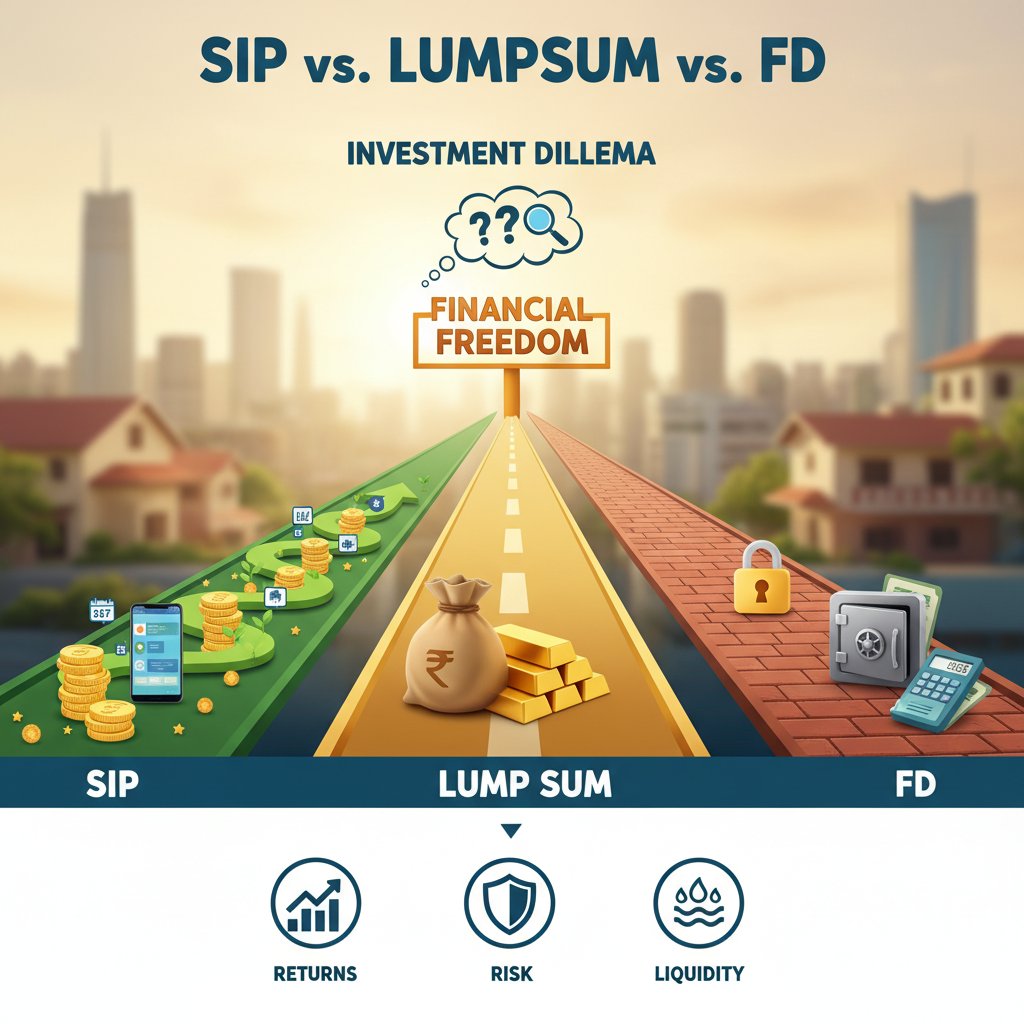
Understanding the Investment Landscape: Your Gateway to Financial Growth
When it comes to building wealth in India, three investment approaches consistently dominate conversations around dining tables, office corridors, and financial planning sessions: Systematic Investment Plans (SIPs), lump sum investments, and Fixed Deposits (FDs).
Table of Contents
- Understanding the Investment Landscape: Your Gateway to Financial Growth
- Systematic Investment Plans (SIPs): The Disciplined Wealth Builder
- The SIP Mechanism: How It Works
- The Power of Rupee Cost Averaging
- SIP Advantages: Why Millions Choose This Path
- SIP Disadvantages: The Flip Side
- Lump Sum Investments: The Strategic Wealth Accelerator
- Understanding Lump Sum Dynamics
- When Lump Sum Makes Sense
- Lump Sum Advantages: The Power Play
- Lump Sum Disadvantages: The Risk Factor
- Fixed Deposits: The Reliable Wealth Preserver
- The FD Framework: Guaranteed Growth
- Types of Fixed Deposits
- FD Advantages: The Safety Net
- FD Disadvantages: The Growth Limitation
- Detailed Performance Comparison: Numbers That Tell the Story
- 5-Year Investment Scenario
- 15-Year Investment Scenario
- Real-World Case Study: The Sharma Family’s Investment Journey
- Risk Analysis: Understanding What You’re Getting Into
- SIP Risk Profile
- Lump Sum Risk Profile
- Fixed Deposit Risk Profile
- Tax Implications: The Often Overlooked Factor
- SIP Taxation
- Lump Sum Taxation
- Fixed Deposit Taxation
- Tax Efficiency Comparison
- Liquidity Considerations: When You Need Your Money
- SIP Liquidity
- Lump Sum Liquidity
- Fixed Deposit Liquidity
- Choosing the Right Strategy: A Decision Framework
- Choose SIP If You:
- Choose Lump Sum If You:
- Choose Fixed Deposits If You:
- The Hybrid Approach: Best of All Worlds
- Digital Platforms and Tools: Making Investment Accessible
- Popular SIP and Mutual Fund Platforms
- Fixed Deposit Platforms
- Key Features to Look For
- Common Mistakes and How to Avoid Them
- SIP Mistakes
- Lump Sum Mistakes
- Fixed Deposit Mistakes
- Future Trends and Considerations
- Emerging Trends
- Regulatory Developments
- Building Your Investment Action Plan
- Step 1: Financial Health Check
- Step 2: Goal Setting and Prioritization
- Step 3: Risk Assessment
- Step 4: Asset Allocation Strategy
- Step 5: Implementation and Monitoring
- Frequently Asked Questions
- Q1: Can I switch from SIP to lump sum or vice versa?
- Q2: What’s the minimum amount needed to start each investment type?
- Q3: How do I choose between equity and debt funds for SIP?
- Q4: Is it better to invest in direct or regular mutual funds?
- Q5: How often should I review my investment portfolio?
- Q6: What happens to my SIP if I miss a monthly payment?
- Q7: Are fixed deposits completely risk-free?
- Q8: Can I get loan against my mutual fund investments?
- Q9: What’s the tax implication if I switch between mutual fund schemes?
- Q10: Should I invest in multiple SIPs or increase existing SIP amount?
- Q11: How do I handle market volatility with lump sum investments?
- Q12: What’s the ideal portfolio mix for a 30-year-old professional?
Understanding these differences is the foundation of smart money management that can transform your financial future.
The beauty of India’s investment ecosystem lies in its diversity. Whether you’re a fresh graduate earning ₹30,000 monthly, a mid-career professional with a bonus, or someone nearing retirement seeking stability, there’s an investment approach tailored for your situation.
Key Insight: According to the Association of Mutual Funds in India (AMFI), SIP contributions have grown from ₹6,000 crores monthly in 2018 to over ₹15,000 crores in 2024, while bank deposits continue to attract over ₹150 lakh crores annually, highlighting the coexistence of different investment philosophies.
Systematic Investment Plans (SIPs): The Disciplined Wealth Builder
A Systematic Investment Plan represents the steady, consistent approach to building wealth in the investment world.
The SIP Mechanism: How It Works
A SIP is an investment vehicle that allows you to invest a fixed amount regularly typically monthly into mutual fund schemes. Instead of trying to time the market or worrying about having a large sum ready, you commit to investing a predetermined amount, say ₹5,000, on the same date every month.
On your chosen date, the amount is automatically debited from your bank account and invested in your selected mutual fund scheme. The number of units you receive depends on the Net Asset Value (NAV) of the fund on that particular day. When markets are high, you get fewer units; when markets are low, you get more units. This creates a natural averaging effect over time.
The Power of Rupee Cost Averaging
Consider this real-world example: Rajesh started a SIP of ₹10,000 monthly in January 2020. During the market crash in March 2020, while his friends panicked, his SIP continued buying more units at lower prices. When markets recovered by 2021, those “crash units” became incredibly valuable. This is rupee cost averaging in action your regular investment buys more when prices are low and fewer when prices are high, smoothing out market volatility.
| Month | Investment Amount | NAV | Units Purchased |
|---|---|---|---|
| January | ₹10,000 | ₹100 | 100 |
| February | ₹10,000 | ₹80 | 125 |
| March | ₹10,000 | ₹60 | 166.67 |
| April | ₹10,000 | ₹90 | 111.11 |
| Total | ₹40,000 | Average: ₹82.5 | 502.78 |
SIP Advantages: Why Millions Choose This Path
Disciplined Investing: SIPs transform investing from an occasional activity into a habit. This discipline is crucial because most investment failures stem from inconsistency, not poor fund selection.
Lower Entry Barrier: You don’t need ₹1 lakh to start investing. Most SIPs allow you to begin with as little as ₹500 monthly. This democratizes investing, making it accessible to students, young professionals, and anyone with modest income.
Flexibility and Control: Life changes, and your SIP can adapt. You can increase, decrease, pause, or stop your SIP based on your financial situation. Many platforms now offer step-up SIPs that automatically increase your investment amount annually, aligning with salary increments.
Power of Compounding: With SIPs, you’re not just investing money; you’re investing time. A 25-year-old investing ₹5,000 monthly until retirement can accumulate significantly more wealth than someone starting the same SIP at 35.
SIP Disadvantages: The Flip Side
Market Risk Exposure: Unlike fixed deposits, SIPs invest in market-linked instruments. Your returns aren’t guaranteed, and you might see negative returns in the short term. During bear markets, watching your portfolio value decline can be emotionally challenging.
Requires Long-term Commitment: SIPs work best over extended periods typically 7-10 years or more. If you need money within 2-3 years, SIPs might not be ideal due to market volatility and exit load charges.
No Immediate Tax Benefits: Unlike ELSS (Equity Linked Savings Scheme) SIPs, regular SIPs don’t offer upfront tax deductions under Section 80C, though long-term capital gains taxation is favorable.
Lump Sum Investments: The Strategic Wealth Accelerator
If SIP is planting seeds regularly in your garden, lump sum investing is transplanting a full-grown tree. You’re making a significant, one-time investment with the expectation of substantial growth over time.
Understanding Lump Sum Dynamics
A lump sum investment involves investing a substantial amount typically ₹1 lakh or more in one go into mutual funds, stocks, or other investment vehicles. This approach requires you to have accumulated capital and the conviction to deploy it entirely at a specific point in time.
The success of lump sum investing heavily depends on market timing and the investment horizon. Unlike SIPs, where market timing becomes less critical due to averaging, lump sum investments can be significantly impacted by when you enter the market.
When Lump Sum Makes Sense
Windfall Situations: Received a bonus, inheritance, or proceeds from selling property? Lump sum investing can be an excellent way to deploy this capital immediately rather than letting it sit idle in a savings account earning minimal returns.
Market Opportunities: Experienced investors who understand market cycles might choose lump sum investing during market downturns. The 2008 financial crisis or the March 2020 COVID crash presented such opportunities for those with available capital and strong nerves.
Shorter Investment Horizons: If you have 3-5 years for your investment to grow and a lump sum available, this approach might generate better returns than starting a SIP, especially if you’re investing during favorable market conditions.
Lump Sum Advantages: The Power Play
Maximum Market Exposure: Your entire capital starts working immediately. If markets perform well post-investment, lump sum can generate superior returns compared to SIP, where money enters the market gradually.
Lower Transaction Costs: Making one large investment typically incurs lower proportional costs compared to multiple small SIP transactions over time.
Simplicity: One decision, one transaction, and you’re done. There’s no need to monitor monthly debits or manage ongoing SIP logistics.
Lump Sum Disadvantages: The Risk Factor
Timing Risk: What if you invest at a market peak? The infamous example of investors who put lump sums just before the 2008 crash had to wait years to recover their capital. This timing risk is the biggest challenge with lump sum investing.
Emotional Stress: Watching a large investment lose value can be emotionally devastating. The psychological impact of seeing ₹10 lakhs become ₹7 lakhs is far greater than watching a ₹5,000 monthly SIP fluctuate.
Requires Significant Capital: Not everyone has large sums readily available for investment. This approach is inherently exclusive to those with substantial savings or windfall gains.
Fixed Deposits: The Reliable Wealth Preserver
Fixed Deposits represent the most conservative approach to growing money, prioritizing capital preservation over wealth multiplication.
The FD Framework: Guaranteed Growth
A Fixed Deposit is a financial instrument where you deposit a lump sum with a bank or financial institution for a predetermined period at a fixed interest rate. The bank guarantees to return your principal along with the promised interest at maturity, regardless of economic conditions or market performance.
Currently, most banks offer FD interest rates ranging from 6% to 7.5% per annum for retail customers, with some small finance banks offering slightly higher rates. The Deposit Insurance and Credit Guarantee Corporation (DICGC) insures deposits up to ₹5 lakhs per bank, adding an extra layer of security.
Types of Fixed Deposits
Regular Fixed Deposits: The standard offering where you deposit money for a fixed tenure and receive interest either monthly, quarterly, or at maturity.
Tax Saver Fixed Deposits: These come with a mandatory 5-year lock-in period but offer tax deductions under Section 80C up to ₹1.5 lakhs annually.
Flexi Fixed Deposits: These allow partial withdrawals while maintaining the FD structure for the remaining amount, offering liquidity with reasonable returns.
Senior Citizen FDs: Banks typically offer 0.25% to 0.50% additional interest to senior citizens, recognizing their need for stable income.
FD Advantages: The Safety Net
Guaranteed Returns: Unlike market-linked investments, FDs offer predetermined returns. If a bank promises 7% annually, you’ll receive exactly that, making financial planning predictable.
Capital Protection: Your principal amount is completely safe (up to ₹5 lakhs per bank due to DICGC insurance). Even if the bank faces difficulties, deposit insurance ensures you don’t lose your money.
Liquidity Options: While premature withdrawal attracts penalties, FDs still offer reasonable liquidity compared to other fixed-income instruments. Many banks allow loans against FDs at attractive rates.
No Market Knowledge Required: You don’t need to understand market dynamics, fund management, or economic cycles. Simply choose the tenure and interest rate that suits your needs.
FD Disadvantages: The Growth Limitation
Inflation Risk: With current inflation rates often matching or exceeding FD returns, your real purchasing power might actually decline over time. ₹1 lakh today won’t have the same buying power after 5 years, even with FD interest.
Tax Inefficiency: FD interest is taxed as per your income tax slab, and TDS is deducted if interest exceeds ₹40,000 annually (₹50,000 for senior citizens). This significantly reduces post-tax returns.
Limited Growth Potential: FDs rarely beat inflation significantly or create substantial wealth over long periods. They’re wealth preservers, not wealth creators.
Detailed Performance Comparison: Numbers That Tell the Story
To understand the real impact of these investment choices, let’s examine how ₹1 lakh invested through each method would perform over different time horizons, assuming realistic return expectations.
5-Year Investment Scenario
| Investment Type | Initial Amount | Expected Annual Return | Final Value | Total Gain |
|---|---|---|---|---|
| Fixed Deposit (7%) | ₹1,00,000 | 7% | ₹1,40,255 | ₹40,255 |
| Lump Sum Equity (12%) | ₹1,00,000 | 12% | ₹1,76,234 | ₹76,234 |
| SIP Equity (₹1,667/month) | ₹1,00,000 total | 12% | ₹1,12,649 | ₹12,649 |
Note: SIP shows lower absolute returns because money enters gradually, not all at once.
15-Year Investment Scenario
| Investment Type | Total Investment | Expected Annual Return | Final Value | Total Gain |
|---|---|---|---|---|
| Fixed Deposit (7%) | ₹1,00,000 | 7% | ₹2,75,903 | ₹1,75,903 |
| Lump Sum Equity (12%) | ₹1,00,000 | 12% | ₹5,47,357 | ₹4,47,357 |
| SIP Equity (₹5,556/month) | ₹10,00,000 total | 12% | ₹20,01,974 | ₹10,01,974 |
Real-World Case Study: The Sharma Family’s Investment Journey
Meet the Sharmas a middle-class family from Pune. In 2010, they had ₹5 lakhs to invest and chose three different approaches:
- ₹2 lakhs in FD at 8% annual interest
- ₹2 lakhs lump sum in a diversified equity mutual fund
- ₹1 lakh spread over SIPs at ₹10,000 monthly for 10 months, then continued
By 2024 (14 years later), here’s how their investments performed:
- FD Value: ₹6,09,000 (consistent, predictable growth)
- Lump Sum Value: ₹12,80,000 (despite market volatilities, equity delivered)
- SIP Value: ₹45,60,000 (₹16.8 lakhs invested over 14 years)
This real-world example illustrates how different approaches serve different purposes and how combining them can create a balanced portfolio.
Risk Analysis: Understanding What You’re Getting Into
Every investment carries risk even the “safe” fixed deposit faces inflation risk. Understanding these risks helps you make informed decisions aligned with your comfort level and financial goals.
SIP Risk Profile
Market Risk (Medium to High): SIP returns depend on underlying fund performance, which fluctuates with market conditions. However, rupee cost averaging reduces timing risk significantly.
Inflation Risk (Low): Equity-oriented SIPs historically outpace inflation over long periods, protecting your purchasing power.
Liquidity Risk (Low to Medium): Most SIPs offer good liquidity, though exit loads might apply for redemptions within one year.
Credit Risk (Low): When investing through reputable fund houses regulated by SEBI, credit risk is minimal.
Lump Sum Risk Profile
Market Risk (High): Timing risk is the biggest concern. Investing just before a market crash can result in significant short-term losses.
Concentration Risk (Medium to High): Putting all money to work at once means you’re fully exposed to market conditions at that specific time.
Emotional Risk (High): Large losses can trigger panic selling, turning temporary market downturns into permanent losses.
Fixed Deposit Risk Profile
Inflation Risk (High): The biggest risk with FDs is that returns might not keep pace with inflation, eroding real purchasing power over time.
Interest Rate Risk (Medium): If interest rates rise after you lock in your FD, you miss out on higher returns available in the market.
Tax Risk (Medium): FD interest is taxed as per your income slab, potentially reducing post-tax returns significantly for high earners.
Credit Risk (Very Low): With DICGC insurance up to ₹5 lakhs per bank, credit risk is minimal for most retail investors.
Tax Implications: The Often Overlooked Factor
Taxation can significantly impact your investment returns, yet many investors overlook this crucial aspect when making investment decisions.
SIP Taxation
Equity Mutual Funds:
- Short-term capital gains (holding period less than 1 year): 15% tax
- Long-term capital gains (holding period more than 1 year): 10% tax on gains exceeding ₹1 lakh annually
- No tax on dividends in the hands of investors (fund houses pay dividend distribution tax)
Debt Mutual Funds:
- Short-term capital gains: Taxed as per your income tax slab
- Long-term capital gains: 20% with indexation benefits
Lump Sum Taxation
Lump sum investments follow the same taxation rules as SIPs, but the holding period calculation starts from the investment date, making tax planning more straightforward.
Fixed Deposit Taxation
Interest Taxation:
- FD interest is added to your total income and taxed as per your slab rate
- Banks deduct TDS at 10% if interest exceeds ₹40,000 annually (₹50,000 for senior citizens)
- No indexation benefits or preferential tax treatment
Tax-Saving FDs:
- Offer Section 80C deduction up to ₹1.5 lakhs
- 5-year mandatory lock-in period
- Interest still taxable as per income slab
Tax Efficiency Comparison
For a person in the 30% tax bracket investing ₹1 lakh:
| Investment | Gross Return (10 years) | Tax Impact | Post-Tax Return |
|---|---|---|---|
| Equity SIP (12% CAGR) | ₹3,10,585 | ₹21,058 (10% LTCG) | ₹2,89,527 |
| FD (7% annual) | ₹1,96,715 | ₹29,015 (30% on interest) | ₹1,67,700 |
Liquidity Considerations: When You Need Your Money
Life is unpredictable, and sometimes you need access to your investments before planned. Understanding liquidity features can prevent financial stress during emergencies.
SIP Liquidity
Open-ended Funds: Most SIPs invest in open-ended mutual funds, offering excellent liquidity. You can redeem your units on any business day and receive money within 1-3 working days.
Exit Load Considerations: Many funds charge exit loads (typically 1%) for redemptions within one year of investment to discourage short-term trading.
Partial Redemption: You can redeem any number of units without affecting your ongoing SIP, providing flexibility during financial crunches.
Lump Sum Liquidity
Lump sum investments in mutual funds offer the same liquidity as SIPs you can exit partially or completely based on your needs. However, the psychological impact of redeeming a large investment during market downturns can be significant.
Fixed Deposit Liquidity
Premature Withdrawal: Most banks allow premature FD withdrawal but charge penalties (typically 0.5% to 1% reduction in interest rate).
Loan Against FD: Banks offer loans against FDs at attractive rates (typically 1-2% above FD rate), providing liquidity without breaking the deposit.
Sweep-in FDs: These automatically convert excess savings account balance into FDs and sweep back when needed, optimizing returns while maintaining liquidity.
Choosing the Right Strategy: A Decision Framework
Selecting between SIP, lump sum, and FD isn’t about finding the “best” option it’s about finding the right fit for your specific situation, goals, and personality.
Choose SIP If You:
- Have regular monthly income but limited lump sum savings
- Want to build investment discipline and make it automatic
- Are comfortable with market volatility for long-term gains
- Have investment horizon of 5+ years
- Want to benefit from rupee cost averaging
- Are new to investing and want to start small
Choose Lump Sum If You:
- Have substantial idle money earning low returns
- Believe current market conditions are favorable
- Have experience with market investing
- Can emotionally handle short-term volatility
- Want maximum market exposure immediately
- Have received windfall gains (bonus, inheritance, etc.)
Choose Fixed Deposits If You:
- Prioritize capital safety over growth
- Need predictable returns for financial planning
- Are nearing retirement or have short-term goals
- Cannot afford any risk to your principal
- Want simple, hassle-free investments
- Are building an emergency fund
The Hybrid Approach: Best of All Worlds
Many successful investors don’t choose one approach exclusively. Instead, they create a balanced portfolio:
- 30% in FDs for emergency funds and short-term goals
- 50% in SIPs for long-term wealth creation
- 20% for lump sum opportunities during market corrections
This approach provides stability, growth, and flexibility to capitalize on opportunities.
Digital Platforms and Tools: Making Investment Accessible
The digital revolution has transformed how Indians invest, making sophisticated investment strategies accessible through smartphone apps and web platforms.
Popular SIP and Mutual Fund Platforms
Groww: User-friendly interface perfect for beginners, offering direct mutual funds with zero commission. Features include SIP calculators, goal-based investing, and comprehensive fund research tools.
Zerodha Coin: Part of India’s largest discount brokerage, Coin offers direct mutual funds with no transaction charges. Integrated with Kite trading platform for comprehensive portfolio management.
Paytm Money: Leverages Paytm’s ecosystem for seamless payments and offers commission-free direct mutual fund investments. Strong focus on goal-based SIPs and financial planning.
ET Money: Backed by Times Group, offers comprehensive mutual fund platform with expert recommendations and portfolio analysis tools.
Fixed Deposit Platforms
Stable Money: Aggregates FD offerings from multiple banks, allowing comparison and booking of best rates from a single platform. Offers features like FD laddering and renewal reminders.
BankBazaar: Compares FD rates across banks and provides online booking facility. Also offers other financial products for comprehensive financial planning.
Key Features to Look For
- Regulatory Compliance: Ensure platforms are SEBI-registered and follow proper compliance procedures
- Direct Fund Access: Choose platforms offering direct mutual funds to save on commission costs
- Research Tools: Look for platforms providing fund analysis, performance comparison, and risk assessment tools
- Goal-based Planning: Features that help align investments with specific financial goals
- Customer Support: Reliable customer service for query resolution and technical support
Common Mistakes and How to Avoid Them
Learning from others’ mistakes can save you significant money and heartache in your investment journey.
SIP Mistakes
Stopping SIPs During Market Downturns: This is the biggest mistake SIP investors make. Market downturns are when SIPs work best, buying more units at lower prices. Continuing SIPs during 2008 and 2020 crashes proved extremely rewarding for patient investors.
Starting Too Many SIPs: Diversification is good, but over-diversification dilutes returns. Starting SIPs in 10 different funds doesn’t necessarily reduce risk it might just increase complexity and costs.
Choosing Wrong Fund Categories: Investing in debt funds through SIP when your goal is long-term wealth creation, or choosing sectoral funds without understanding concentration risks.
Lump Sum Mistakes
Trying to Time the Market: Waiting for the “perfect” time to invest often means missing out on years of potential growth. Time in the market beats timing the market.
Panic Selling: Selling during market downturns locks in losses and prevents recovery participation. The key is having a long-term perspective and strong conviction.
Putting All Eggs in One Basket: Investing the entire lump sum in a single fund or sector increases concentration risk significantly.
Fixed Deposit Mistakes
Ignoring Inflation: Focusing only on nominal returns without considering inflation’s impact on purchasing power leads to wealth erosion over time.
Not Optimizing Tax: High earners putting money in regular FDs instead of exploring tax-saving alternatives or debt mutual funds with indexation benefits.
Ladder Mismanagement: Not creating FD ladders for regular income needs or emergency fund optimization.
Future Trends and Considerations
The investment landscape continues evolving, influenced by technology, regulation, and changing investor behavior.
Emerging Trends
Goal-based Investing: Platforms increasingly focus on linking investments to specific goals (child’s education, retirement, house purchase) rather than generic wealth creation.
AI-driven Advisory: Robo-advisors using artificial intelligence to provide personalized investment recommendations based on risk profile, goals, and market conditions.
ESG Integration: Growing focus on Environmental, Social, and Governance (ESG) factors in investment decisions, with more ESG-focused mutual funds launching.
Cryptocurrency Integration: While regulatory clarity is awaited, some platforms are preparing to integrate cryptocurrency investments alongside traditional options.
Regulatory Developments
SEBI Reforms: Continuous efforts to reduce costs, improve transparency, and enhance investor protection in mutual fund industry.
Digital KYC: Streamlined know-your-customer processes making investment onboarding faster and more convenient.
Investor Education: Increased focus on investor awareness and education to promote informed decision-making.
Building Your Investment Action Plan
Knowledge without action remains merely academic. Here’s how to translate understanding into a concrete investment strategy.
Step 1: Financial Health Check
Before investing, ensure you have:
- Emergency fund covering 6-12 months of expenses in liquid form
- Adequate health and life insurance coverage
- High-interest debt (credit cards, personal loans) cleared
- Clear understanding of monthly income and expenses
Step 2: Goal Setting and Prioritization
List your financial goals with timelines:
- Short-term (1-3 years): Emergency fund, vacation, gadget purchase
- Medium-term (3-7 years): Car purchase, house down payment, child’s education
- Long-term (7+ years): Retirement, child’s higher education, wealth creation
Step 3: Risk Assessment
Honestly evaluate your risk tolerance considering:
- Age and earning potential
- Family responsibilities
- Emotional comfort with volatility
- Investment knowledge and experience
Step 4: Asset Allocation Strategy
Based on goals and risk tolerance, create an allocation framework:
| Goal Timeline | Equity Allocation | Debt/FD Allocation | Preferred Method |
|---|---|---|---|
| 1-3 years | 0-20% | 80-100% | FD, Liquid Funds |
| 3-7 years | 30-60% | 40-70% | SIP + FD combination |
| 7+ years | 60-80% | 20-40% | SIP focused with some FD |
Step 5: Implementation and Monitoring
- Start with small amounts to build confidence
- Automate investments to ensure consistency
- Review portfolio quarterly, rebalance annually
- Increase SIP amounts with salary increments
- Stay informed but avoid daily portfolio checking
Frequently Asked Questions
Q1: Can I switch from SIP to lump sum or vice versa?
Yes, mutual fund investments offer complete flexibility. You can stop your SIP and make lump sum investments in the same fund, or start SIPs even if you’ve made lump sum investments previously. Many investors use both approaches simultaneously based on cash flow availability.
Q2: What’s the minimum amount needed to start each investment type?
SIPs can start from as low as ₹500 per month in most mutual funds. Lump sum mutual fund investments typically require a minimum of ₹5,000, though some funds accept ₹1,000. Fixed deposits usually start from ₹1,000, but some banks may have higher minimum requirements.
Q3: How do I choose between equity and debt funds for SIP?
Your choice should align with investment timeline and risk tolerance. For goals beyond 5-7 years, equity funds historically provide better inflation-adjusted returns. For shorter timelines or conservative investors, debt funds or balanced funds might be more appropriate. Consider starting with balanced advantage funds if you’re unsure.
Q4: Is it better to invest in direct or regular mutual funds?
Direct mutual funds are generally better as they don’t charge distributor commissions, resulting in higher returns over time. The expense ratio difference might seem small (0.5-1%), but compounds significantly over long periods. Use SEBI-registered platforms or AMC websites for direct fund investments.
Q5: How often should I review my investment portfolio?
Review your portfolio quarterly to ensure it aligns with your goals, but avoid making frequent changes based on short-term market movements. Annual rebalancing is usually sufficient unless there are significant life changes or goal modifications.
Q6: What happens to my SIP if I miss a monthly payment?
Missing 1-2 SIP installments won’t cancel your SIP automatically. However, if your bank account has insufficient funds for 3 consecutive months, most fund houses will cancel the SIP. You can restart it anytime or make manual investments to continue your investment journey.
Q7: Are fixed deposits completely risk-free?
While FDs protect your capital (up to ₹5 lakhs per bank due to DICGC insurance), they carry inflation risk. If inflation exceeds FD returns, your purchasing power decreases over time. They’re capital-safe but not necessarily wealth-preserving in real terms.
Q8: Can I get loan against my mutual fund investments?
Yes, many banks and NBFCs offer loans against mutual fund units, typically providing 50-80% of the portfolio value as loan amount. This provides liquidity without selling your investments, though you’ll pay interest on the borrowed amount.
Q9: What’s the tax implication if I switch between mutual fund schemes?
Switching between mutual fund schemes is considered redemption from one fund and fresh investment in another, triggering capital gains tax. However, some fund houses offer direct switching facilities within their fund family, which still attracts tax but provides convenience.
Q10: Should I invest in multiple SIPs or increase existing SIP amount?
Generally, increasing existing SIP amounts in well-performing, diversified funds is more efficient than starting multiple SIPs. However, if you want exposure to different categories (large-cap, mid-cap, international) or are hitting investment limits in specific funds, multiple SIPs make sense.
Q11: How do I handle market volatility with lump sum investments?
Consider systematic transfer plans (STP) where you invest your lump sum in a liquid fund and systematically transfer fixed amounts to equity funds over 6-12 months. This provides some averaging benefit while keeping your money invested rather than sitting idle.
Q12: What’s the ideal portfolio mix for a 30-year-old professional?
A common rule of thumb is to invest (100 – age)% in equity. For a 30-year-old, this suggests 70% equity and 30% debt/FD allocation. However, consider your risk tolerance, financial goals, and family responsibilities when determining your actual allocation. Start conservative and gradually increase equity exposure as you gain experience and confidence.
Remember, successful investing isn’t about finding the perfect strategy it’s about starting early, staying consistent, and making informed decisions aligned with your financial goals and risk tolerance. Whether you choose SIPs, lump sum investments, or fixed deposits, the key is to begin your investment journey and adapt as you learn and grow.